
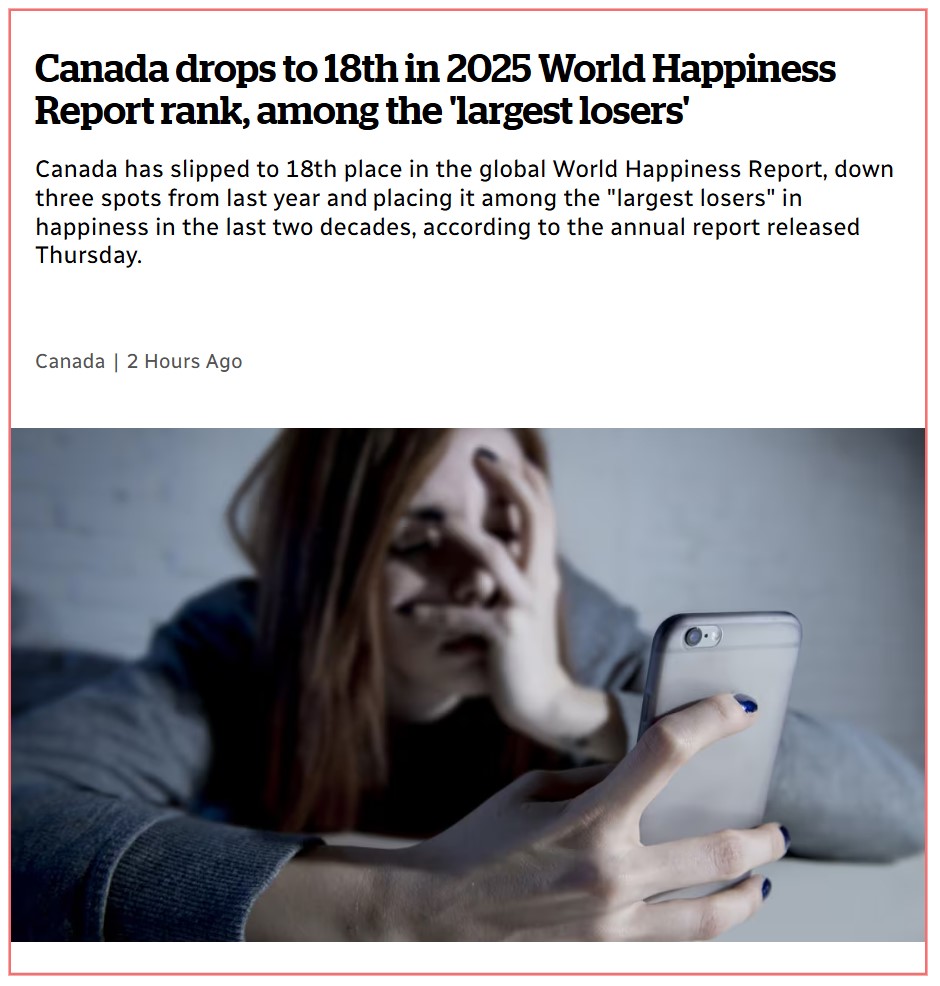
There is a growing body of evidence suggesting that increased social media use is associated with lower happiness and well-being, especially among adolescents and young adults. However, the relationship is complex:
In either case, so called 'social' media pulls us away from real, face-to-face society. And instead, places us alone, in front of our devices.
What the research finds...
Many large-scale studies have found that people who spend more time on social media tend to report:
The strongest concerns are generally among teenage girls, though effects are seen across many groups.
A key caveat: correlation does not prove causation.

Some of the most interesting studies have asked people to deliberately reduce their social media use.
Researchers at the University of Pennsylvania found that students limited to about 30 minutes/day of social media showed reductions in loneliness and depressive symptoms compared with a control group.
Other experiments have found that:
These studies provide stronger evidence that social media can contribute to declines in well-being.

As humans, we naturally compare ourselves to others ('social comparison').
Historically, we compared ourselves to:
Today we compare ourselves to:
The result is a constant sense that everyone else is happier, richer, fitter, more successful, and more attractive.
Researchers consistently identify social comparison as one of the strongest mechanisms linking social media to unhappiness.
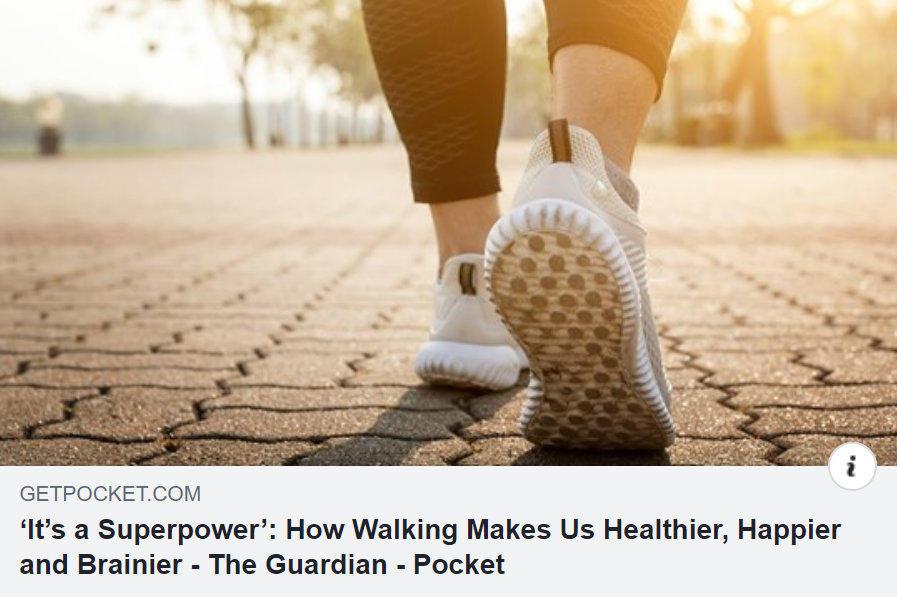
Time spent scrolling is time not spent:
Many researchers believe the roblem is not merely social media itself, but what it replaces.

Social media platforms are designed to maximize engagement.
They provide:
Many users report:
Some psychologists argue this erodes the kinds of experiences most associated with lasting well-being:
Most platforms reward content that generates strong reactions.
Anger, fear, and conflict tend to spread further than calm, nuanced discussion.
Researchers have documented how algorithmic systems amplify:
Spending large amounts of time in these environments can create a perception that society is far more hostile than one's actual day-to-day experience.
The age effect
The strongest evidence of harm concerns adolescents.
Researchers such as Jonathan Haidt and Jean Twenge have argued that the rise of smartphones and social media around 2010 coincides with significant increases in:
among teenagers.
Some researchers agree strongly with this interpretation; others believe the evidence is more mixed. There is active debate about the magnitude of the effect, but relatively little debate that heavy use can be harmful for some users.
Are there benefits?
Yes. Social media can:
For many people, moderate and intentional use appears relatively harmless and can even be beneficial.
The strongest negative effects seem associated with:
rather than active communication with people one actually knows.
When researchers ask people what activities make them happiest, the winners tend to be surprisingly old-fashioned:
These are also precisely the activities that heavy social media use can displace.
Many of the activities most associated with happiness occur largely outside social media and in real-world communities.
That observation has become a recurring theme in recent research on well-being, social capital, and civic participation
There is extensive and growing evidence linking declines in happiness to heavy social media use, particularly among young people in Western countries. [1]
Large-scale studies and international reports point to several specific correlations and mechanisms: [1]
Despite these correlations, researchers note that social media is a "double-edged sword". Platforms can provide vital social connection and peer support, particularly for marginalized communities, if used actively to engage with friends and peers. [1, 2, 3, 5]
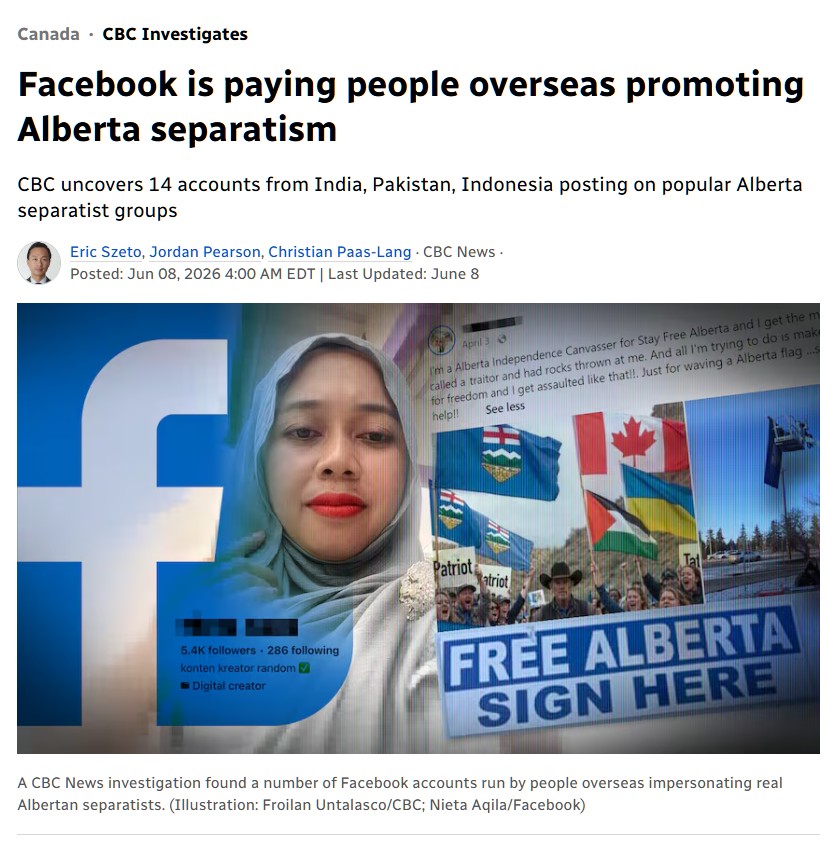
Are the corporations who control 'social' media algorithms manipulating elections, democracy? Or even trying to destroy Canada?
Disclaimer: The above is provided on an "As Is" basis and for general informational purposes only. People and Planet (also known as "GoodWork") is not responsible for the content, accuracy, timeliness, completeness, legality, reliability, quality or suitability of this posting. This page is intended to highlight just a few of the downsides of social media, in a world where it's spinning out of control. Of course, the pros and cons of social media in your case may be different. Please do your own research – preferrably *off* social media – to decide what is best for you. Quitting suddenly may cause withdrawal symptoms. If needed, please consult medical/professional help.
Note: The above is provided on an "As Is" basis and for general informational purposes only. People and Planet (also known as "GoodWork") is not responsible for the content, accuracy, timeliness, completeness, legality, reliability, quality or suitability of this posting. We do not screen or endorse the organizations or individuals involved. If you decide to accept an offer of employment, volunteering or any other arrangement, you do so at your own risk and it is your responsibility to take all protective measures to guard against injury, abuse, non-payment or any other loss. Please read our full Terms & Conditions.